The Q3ToolBar class provides a movable panel containing widgets such as tool buttons. 更多...
| 頭: | #include <Q3ToolBar> |
| 繼承: | Q3DockWindow |
| Q3ToolBar (const QString & label , Q3MainWindow * parent , Qt::ToolBarDock dock = Qt::DockTop, bool newLine = false, const char * name = 0) | |
| Q3ToolBar (const QString & label , Q3MainWindow * mainWindow , QWidget * parent , bool newLine = false, const char * name = 0, Qt::WindowFlags f = 0) | |
| Q3ToolBar (Q3MainWindow * parent = 0, const char * name = 0) | |
| ~Q3ToolBar () | |
| void | addSeparator () |
| virtual void | clear () |
| QString | label () const |
| Q3MainWindow * | mainWindow () const |
| virtual void | setLabel (const QString &) |
| virtual void | setStretchableWidget (QWidget * w ) |
| virtual bool | event (QEvent * e ) |
| virtual QSize | minimumSizeHint () const |
| virtual void | setOrientation (Qt::Orientation o ) |
| virtual void | setVisible (bool visible ) |
| virtual void | resizeEvent (QResizeEvent * e ) |
The Q3ToolBar class provides a movable panel containing widgets such as tool buttons.
A toolbar is a panel that contains a set of controls, usually represented by small icons. It's purpose is to provide quick access to frequently used commands or options. Within a Q3MainWindow the user can drag toolbars within and between the dock areas . Toolbars can also be dragged out of any dock area to float freely as top-level windows.
Q3ToolBar is a specialization of QDockWindow , and so provides all the functionality of a QDockWindow .
要使用 Q3ToolBar you simply create a Q3ToolBar as a child of a Q3MainWindow , create a number of QToolButton widgets (or other widgets) in left to right (or top to bottom) order and call addSeparator () when you want a separator. When a toolbar is floated the caption used is the label given in the constructor call. This can be changed with setLabel ().
You may use most widgets within a toolbar, with QToolButton and QComboBox being the most common. But note that the toolbar's actions must be Q3Action 。
If you create a new widget on an already visible Q3ToolBar , this widget will automatically become visible without needing a show () call. (This differs from every other Qt widget container. We recommend calling show () anyway since we hope to fix this anomaly in a future release.)
Q3ToolBars, like QDockWindows, are located in Q3DockArea s or float as top-level windows. Q3MainWindow provides four Q3DockAreas (top, left, right and bottom). When you create a new toolbar (as in the example above) as a child of a Q3MainWindow the toolbar will be added to the top dock area. You can move it to another dock area (or float it) by calling Q3MainWindow::moveDockWindow (). Dock areas lay out their windows in lines.
If the main window is resized so that the area occupied by the toolbar is too small to show all its widgets a little arrow button (which looks like a right-pointing chevron, '»') will appear at the right or bottom of the toolbar depending on its orientation. Clicking this button pops up a menu that shows the 'overflowing' items. QToolButtons are represented in the menu using their textLabel property, other QAbstractButton subclasses are represented using their text property, and QComboBoxes are represented as submenus, with the caption text being used in the submenu item.
Usually a toolbar will get precisely the space it needs. However, with setHorizontalStretchable (), setVerticalStretchable () 或 setStretchableWidget () you can tell the main window to expand the toolbar to fill all available space in the specified orientation.
The toolbar arranges its buttons either horizontally or vertically (see orientation () for details). Generally, Q3DockArea will set the orientation correctly for you, but you can set it yourself with setOrientation () and track any changes by connecting to the orientationChanged () 信號。
可以使用 clear () method to remove all items from a toolbar.
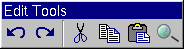
A floating QToolbar (dock window)
另請參閱 QToolButton and Q3MainWindow .
This property holds the toolbar's label.
If the toolbar is floated the label becomes the toolbar window's caption. There is no default label text.
訪問函數:
| QString | label () const |
| virtual void | setLabel (const QString &) |
Constructs an empty toolbar.
The toolbar is called name and is a child of parent and is managed by parent . It is initially located in dock area dock and is labeled label 。若 newLine is true the toolbar will be placed on a new line in the dock area.
Constructs an empty horizontal toolbar.
The toolbar is called name and is a child of parent and is managed by mainWindow 。 label and newLine parameters are passed straight to Q3MainWindow::addDockWindow (). name and the widget flags f 被傳遞給 Q3DockWindow 構造函數。
Use this constructor if you want to create torn-off (undocked, floating) toolbars or toolbars in the 狀態欄 .
這是重載函數。
Constructs an empty toolbar called name ,采用父級 parent , in its parent 's top dock area, without any label and without requiring a newline.
析構函數。
Adds a separator to the right/bottom of the toolbar.
[虛擬]
void
Q3ToolBar::
clear
()
Deletes all the toolbar's child widgets.
[虛擬]
bool
Q3ToolBar::
event
(
QEvent
*
e
)
重實現自 QObject::event ().
返迴指針指嚮 Q3MainWindow which manages this toolbar.
[虛擬]
QSize
Q3ToolBar::
minimumSizeHint
() const
重實現自 QWidget::minimumSizeHint ().
[virtual protected]
void
Q3ToolBar::
resizeEvent
(
QResizeEvent
*
e
)
重實現自 QWidget::resizeEvent ().
[虛擬]
void
Q3ToolBar::
setOrientation
(
Qt::Orientation
o
)
重實現自 Q3DockWindow::setOrientation ().
[虛擬]
void
Q3ToolBar::
setStretchableWidget
(
QWidget
*
w
)
Sets the widget w to be expanded if this toolbar is requested to stretch.
The request to stretch might occur because Q3MainWindow right-justifies the dock area the toolbar is in, or because this toolbar's isVerticalStretchable () 或 isHorizontalStretchable () is set to true.
If you call this function and the toolbar is not yet stretchable, setStretchable() is called.
另請參閱 Q3MainWindow::setRightJustification (), setVerticalStretchable (),和 setHorizontalStretchable ().
[虛擬]
void
Q3ToolBar::
setVisible
(
bool
visible
)
重實現自 QWidget::setVisible ().
